Interrogating the Aesthetics of Digital Reality
The series QUESTIONS ABOUT PERCEPTION is a collection of digitally generated compositions through abstraction, AI collaboration, and conceptual imaging. It investigates the times of temporality, embodiment, memory, the Other, and digital phenomenology. At the center of conceptual exploration is the unstable relationship between seeing and knowing. Each work invites the viewer into a shifting perceptual field, informed by philosophical traditions that resist objectivity and embrace the lived, the felt, and the fragmented. Drawing from Husserl, Bergson, Merleau-Ponty, Levinas, and Stiegler, this series reframes digital art as a site of experiential disruption — where form unfolds as consciousness and distortion becomes meaning, and where the image becomes an uncertain terrain between reality and interpretation. Across various visual strategies, these works not only ask what we see, but also how we perceive, and what perception reveals about being, time, and connection.
Cross-digital techniques
2015 — 2025
questions
perceptions

about
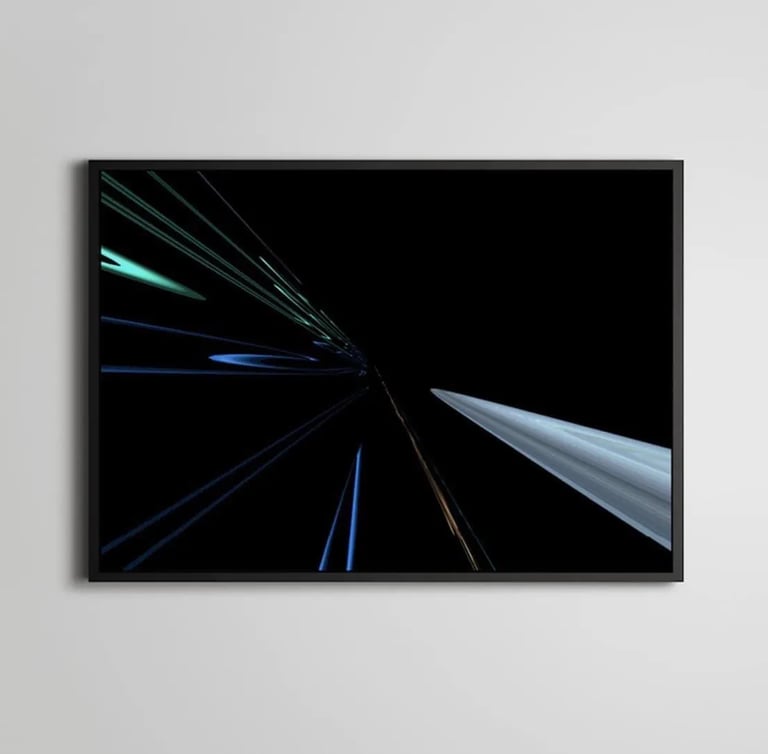
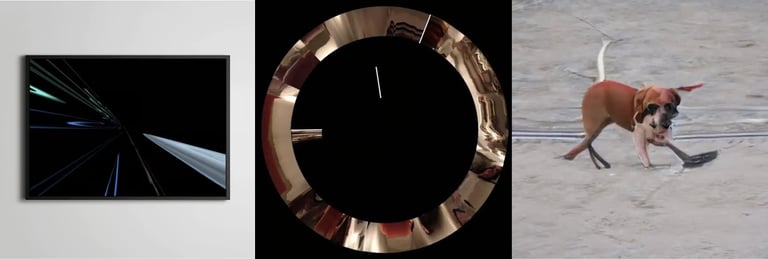
VORTEX (2015) is a series of conceptual representations that capture the phenomenon of suspended time. Through digital abstraction and layered motion, each piece acts as a visual meditation on how temporality becomes perceptible only in distorted, momentary, and deeply subjective fragments. To grasp time through the lens of Husserl’s phenomenology, one must consider it in two distinct yet intertwined modalities. First, as objective time, it serves as the framework in which external phenomena unfold—chronological, measurable, and seemingly linear. Second, and more crucially for this work, internal time reveals itself as a dimension of consciousness, shaped by perception, memory, and anticipation. Past, present, and future do not exist as isolated compartments, but as continuous threads woven into every conscious moment. Within the mind, traces of the past remain active even as the future is projected forward. The swirling convergence of digital forms evokes both motion and stillness, placing the viewer in a suspended perceptual field. The image’s depth collapses conventional time, mirroring Husserl’s notion that consciousness retains vestiges of earlier experiences while simultaneously anticipating what’s to come. The tridimensional frame — space, color, and form — becomes a metaphor for how we cognitively construct time through fragments of reality. Ultimately, VORTEX does not depict time: it is an invitation to inhabit the threshold between external chronology and the inner pulse of memory and expectation.
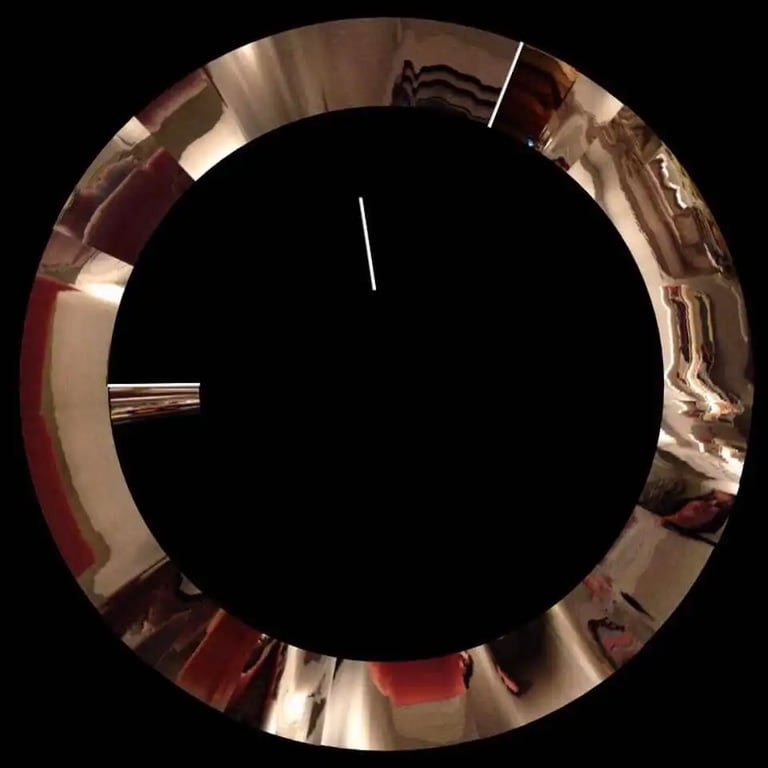
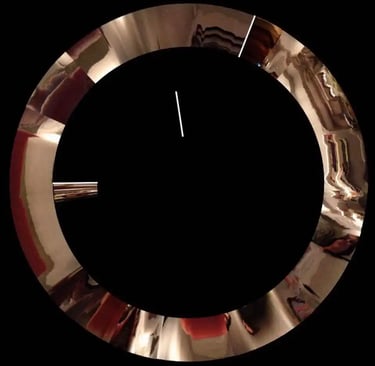
PARALLAX MEMORY (2019) presents a shifting viewpoint in which reality bends alongside the movement of time. This digital composition evokes a concentric, mirrored vortex that refracts and warps its own internal structure, drawing the viewer into a perceptual loop. Rather than depicting a specific event, it embodies a felt movement—an unfolding of inner duration that aligns with Henri Bergson’s concept of la durée, a qualitative, nonlinear experience of time. Within this warped visual space, memory is not static or archived, but active and layered. Echoes of the past intertwine with the present, suggesting Bergson’s belief that perception is inseparable from memory. The recursive reflections embedded in the work convey simultaneity — where different moments coalesce in the experience of now. The mirror functions as a metaphor for mémoire involontaire, offering glimpses into reality altered by recollection. In its digital materiality, the artwork gestures toward virtuality, reminding us that, for Bergson, memory remains latent until drawn into conscious awareness. Just as the image exists in invisible code until rendered, so too does experience hover between being and becoming. Ultimately, this piece is not just a visual object but a conceptual interface that mediates and distorts perception, inviting the viewer into a contemplative space where time folds, memory resonates, and reality momentarily reshapes itself.
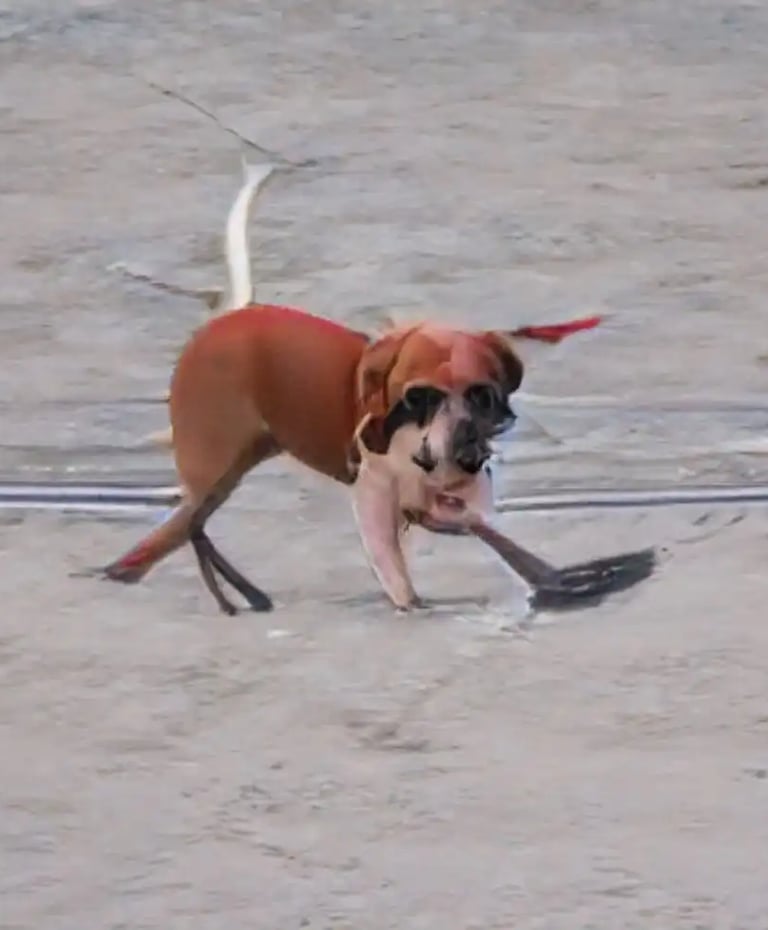
LOVE (2021) stages an uncanny interplay between intimacy, transformation, and the fragile boundaries of identity. A lone dog strides across a sandy surface, but something is off: its limbs, rendered with human musculature, disrupt the familiar. The hybrid form introduces not just surrealism, but a profound gesture of relational collapse. It speaks to the intersections between species, the transgressive edges of embodiment, and the generative potential of digital co-creation. This piece evokes the phenomenology of recognition and estrangement. As Merleau-Ponty suggests, perception here is embodied and unstable — what we know becomes uncertain, and what we feel becomes the medium of truth. The viewer is pulled into a loop of identification and confusion: is this affection made visible, or a disruption of kinship? In the context of Levinas’s ethics of the Other, LOVE becomes encounter. The dog, simultaneously familiar and altered, stands as both companion and question. Levinas posits that the face of the Other resists full comprehension—here, the anthropomorphic twist renders the animal as paradox, both mirrored and unknowable. It is not love as emotion, but love as interruption, as nearness that challenges our singularity. AI plays a silent but essential role — it is the third presence, a technological other mediating vision and memory. Echoing Bernard Stiegler’s reflections on technics and desire, this collaboration between artist and algorithm disrupts notions of authorship and origin. In generating the hybrid body, AI both embodies and destabilizes identity — a gesture of love as expansion, not reduction. The result is a work that resists closure. LOVE is not sentimentality — it’s rupture and invitation, a mirror that refuses to reflect only one species or mind. It asks: What does it mean to see yourself in another when that other is fundamentally altered?
Together, the works within QUESTIONS ABOUT PERCEPTION form a layered inquiry into consciousness and relational space. They do not seek to resolve philosophical dilemmas but rather to inhabit them. Perception is treated not as passive reception, but as an active, unstable mode of truth-seeking. Through digital forms and philosophical echoes, this series speaks to the urgency of sensation in a hyper-mediated world, where perceiving has become more complicated, and more necessary, than ever.