The Aesthetics of Apparatus and Absence
Zones of Visibility is a minimalist video installation (2011) that examines the conditions under which perception becomes possible and how visibility is constructed, mediated, and disrupted in digital environments. The work creates a tension between presence and absence, clarity and opacity, inviting viewers to reflect on the thresholds of perception and the mechanisms that determine what is seen and what remains concealed. Engaging with phenomenological theories, particularly Maurice Merleau-Ponty's understanding of perception as an embodied and relational act, the installation foregrounds the idea that space is not passively received but actively negotiated. The low-positioned glowing screens suggest a horizon line, a liminal zone where visibility emerges from invisibility. The scattered cables and subdued lighting reveal the hidden infrastructures that support digital vision, emphasizing that visibility is always contingent on material systems and technological mediation.
zones of visibility
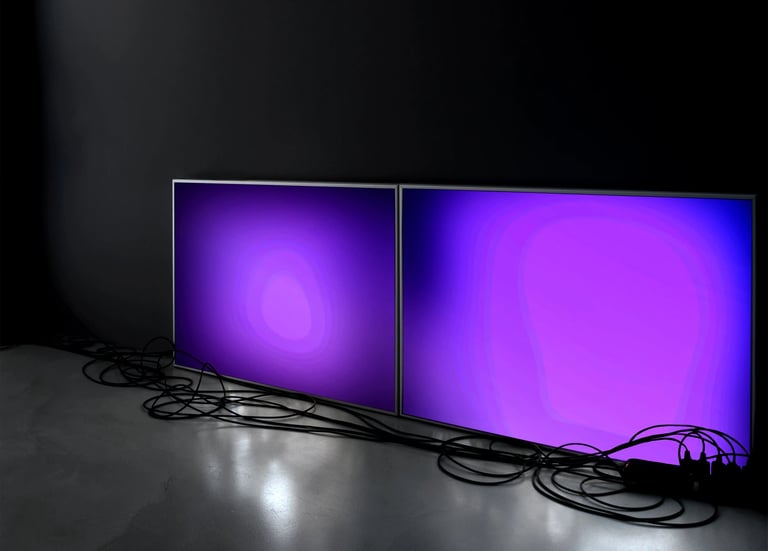
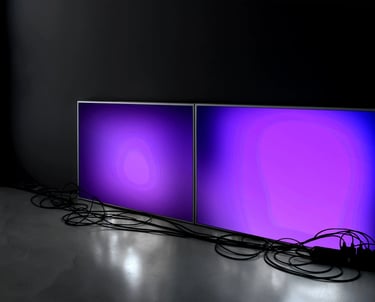
The Zones of Visibility also resonates with media theorists such as Friedrich Kittler and Vilém Flusser, who argue that contemporary vision is shaped by apparatuses rather than the eye alone. The screens do not depict images in the traditional sense but emit gradients of light that resist narrative and instead offer a contemplative field of affect. This visual field slows the gaze and redirects attention toward the act of seeing itself. The work proposes visibility as a zone rather than a given, a shifting terrain shaped by attention, orientation, and technological conditions. It invites viewers to consider the limits of representation and the aesthetic potential of minimal gesture. In doing so, the Zone of Visibility becomes a site of perceptual inquiry, where the viewer is asked not only what they see, but also how and why they see it.